How to generate kernel_params, and go beyond 6 of them? #2

Description

Context: https://twitter.com/rickbrewPDN/status/1562499054952534018
The kernel parameters listed at https://github.com/mikepound/convolve/blob/master/complex_kernels.py are a set of 6 hardcoded 4-vector arrays. I've been having difficulty determining how these are actually generated, and how I might generate kernel parameters beyond the 6 that are listed here (as in, how to calculate for 7, 8, 9, etc.). The explanations I've found are not close enough to my comprehension of the math involved ("it's just a Gaussian kernel with a complex width" ... ??!! 😂 from: http://yehar.com/blog/?p=1495). Every example of Bokeh blur code I've found online lists the same set of pregenerated kernel values, with no code showing how to actually generate them.
My motivation is to experiment with higher "quality" settings in Paint.NET's new Bokeh blur filter. "Quality" is a slider in the UI that controls which set of kernel parameters are used, which is then tied to the number of rendering passes.
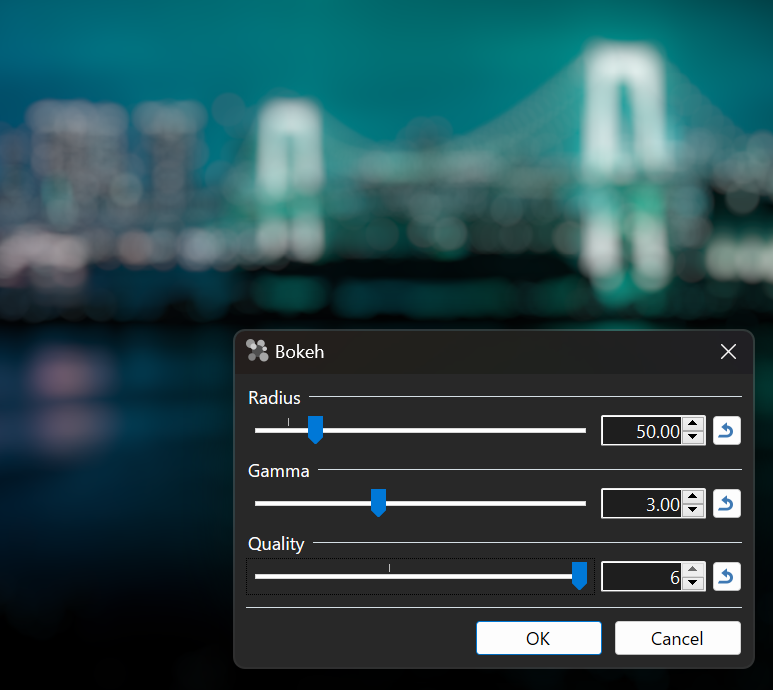
Ringing artifacts are present when there's an imbalance between quality, radius, and the gamma exponent (default is 3). I'm hoping to extend the range at which these values can be combined before artifacts are noticeable (or even eliminating them, if possible). My rendering pipeline is fully 32-bit floating point per pixel component (128-bits total), so there's a lot of room for extra precision vs. the typical 8-bit RGBA32.
My dream solution here would be a function that takes in an integer for the # of components, and returns an array of 4 vectors for the kernel parameters. For example, generate_kernel_parameters(2) would return [[0.886528, 5.268909, 0.411259, -0.548794], [1.960518, 1.558213, 0.513282, 4.56111]] (the numbers from https://github.com/mikepound/convolve/blob/master/complex_kernels.py). I'm not sure how feasible or computationally expensive that is though.