
A software simulation of the Yamaha DX7 with a USB and physical MIDI interface for the Raspberry Pi Pico
Slightly boring video of the picoX7 playing the Yamaha DX7 ROM cartridge 1A patches...
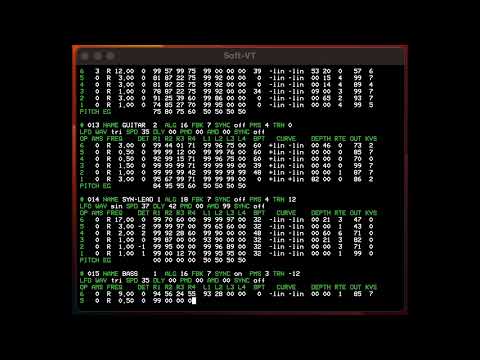
Done...
- I2S (via PIO) 16-bit stereo DAC interface at 49096 Hz
- Use of the 2nd Arm Cortex-M, 8 voices per core
- MIDI in support via UART and USB (including SYSEX in)
- YM21280 OPS simulation (logarithmic)
- YM21290 EGS simulation
- Firmware simulation including pitch envelope, LFO, key sensitivity, level scaling, amplitude modulation
- DX7 voice patches sounding close
To do...
- Tune EGS simulation
- Rate scaling
- Portamento and glissando
- Optimise to squeeze in more voices (?)
Limitations...
- DAC implementation is quite different to the original. Dynamic range might be reduced?
- Hitachi 6303 (~MC6803) CPU controller and firmware are not being emulated or fully simulated
- 8 voices are on the left channel and 8 on the right ... stereo output needs to mixed to mono externally
Deviations/enhancements compared to a real DX7...
- Each voice has it's own LFO
- Each voice has it's own patch state (in theory when supported could load a different patch into each voice)
- Support for 128 voice patches (DX7 had 32 internal and 32 cartridge)
See the software blog and hardware blog for more detailed progress updates.

Schematic for the above.
For more information see README and the hardware blog
The Pico is significantly overclocked to 191.08 MHz to support 16 voices and generate a jitter free sample rate of 49096 Hz.
RP2350 Picos as well as the older RP2040 Picos are supported.
This repo uses git sub-modules, so checkout using --recurse to clone all the dependent source...
git clone --recurse https://github.com/AnotherJohnH/picoX7.git
or
git clone --recurse ssh://git@github.com/AnotherJohnH/picoX7.git
- https://github.com/AnotherJohnH/Platform
- arm-none-eabi-gcc
- cmake via UNIX make or auto detection of ninja if installed
- Python3
- SDL2 (only for native test target)
Being developed on MacOS but should build on Linux too.
Indirect build of all supported targets, rpipico, rpipico2 and native with cmake and make (or ninja)...
make
Build a single hardware target e.g. rpipico2 using cmake...
mkdir build
cd build
cmake -DCMAKE_BUILD_TYPE=Release -DPLT_TARGET=rp2350 -DCMAKE_TOOLCHAIN_FILE=Platform/MTL/rp2350/target/toolchain.cmake ..
make
flashable images will be found under the build sub-directory here...
build/<target>/picoX7_RPIPIOC_I2S_DAC.uf2
build/<target>/picoX7_RPIPIOC_PWM_DAC.uf2
build/<target>/picoX7_RPIPIOC_PIMORONI_PICO_AUDIO.uf2
build/<target>/picoX7_RPIPIOC_WAVESHARE_REV2_1.uf2
build/<target>/picoX7_PIMORONI_VGA_DEMO.uf2
Build the native target...
mkdir build
cd build
cmake -DCMAKE_BUILD_TYPE=Release -DPLT_TARGET=native ..
make
a runable binary image will be found under the build subdirectory here...
build/Source/picoX7_NATIVE
This project is licensed under the MIT License - see the LICENSE file for details
- Ken Shirriff for his very helpful series of blogs reverse engineering the YM21280
- AJXS for their annotated disassembly of the DX7 firmware ROM
- The Dexed developers for providing an easily accessible DX7 audio reference
- The raspberry-pi foundation for the innovative RP2040
- The engineers at Yamaha