
Packages • Contracts • Contributing • Security • License
Othentic is a development framework designed for building robust distributed systems that integrate with Shared security protocols. The network's governance is implemented by AvsGovernance, which is the endpoint for network members' management and deposits. The network has the ability to control stake tokens, depending on the performance of tasks, and vote against bad acting.
To reduce costs and improve efficiency, we deploy AvsGovernance on Layer 1 and AttestationCenter on Layer 2. Since they run on separate networks and can't interact directly on-chain, we use LayerZero to handle message passing between them.
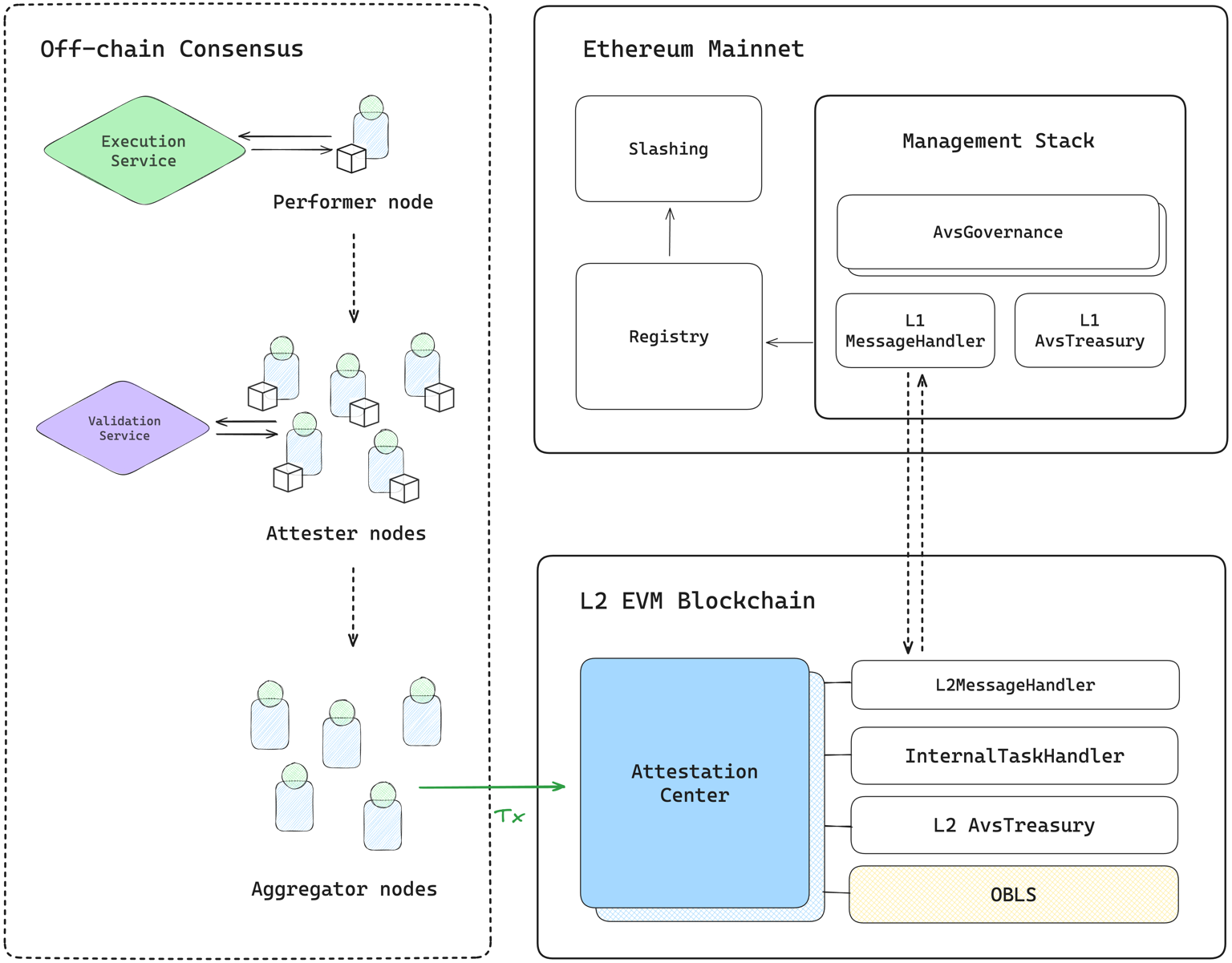
The core contracts fall into the following categories in the GitHub repository:
| Package | Description |
|---|---|
| src/NetworkManagement/L1 | Layer 1 contract implementations |
| src/NetworkManagement/L2 | Layer 2 contract implementations |
| src/NetworkManagement/lz | LayerZero-based messaging interfaces between L1 and L2 |
AvsGovernance: The core governance contract for the AVS that manages Operator registrations, Stake deposits and withdrawals and Protocol-level decision making
AttestationCenteris a contract on Layer 2 that is manage tasks of the AVS validators. It informed by the validators about historical tasks executions and votesOBLSis the contract that implements multisig operationsBN256G2is a cryptographic logical contract that used byOBLS.
Othentic uses LayerZero protocol to facilitate secure cross-layer messaging:
l1MessageHandlerConnected toAvsGovernance, it is an endpoint for communication with Layer 2 components. When activate it act like a router and also a broadcast for Layer 2.l2MessageHandlerConnected toAttestationCenter, this contract is the complement contract tol1MessageHandler, an endpoint for communication with Layer 1.
Communication between layers follows this pattern:
// From Layer 2 → Layer 1
L2MessageHandler.sendMessage(payload)
   ⟶ L1MessageHandler.receive(payload)

// From Layer 1 → Layer 2
L1MessageHandler.sendMessage(payload)
   ⟶ L2MessageHandler.receive(payload)