For the full scope of this project, please see Clarke et al. 2018: https://doi.org/10.3847/1538-4357/aaa0d3
Widely separated binary stars represent a unique coeval laboratory in which to conduct age-activity-rotation studies. Here we present a comparison of relative flare activity between 58 previously identified wide binaries, showing that while most pairs display similar activity, some pairs (that we classify as 'outliers') do not.
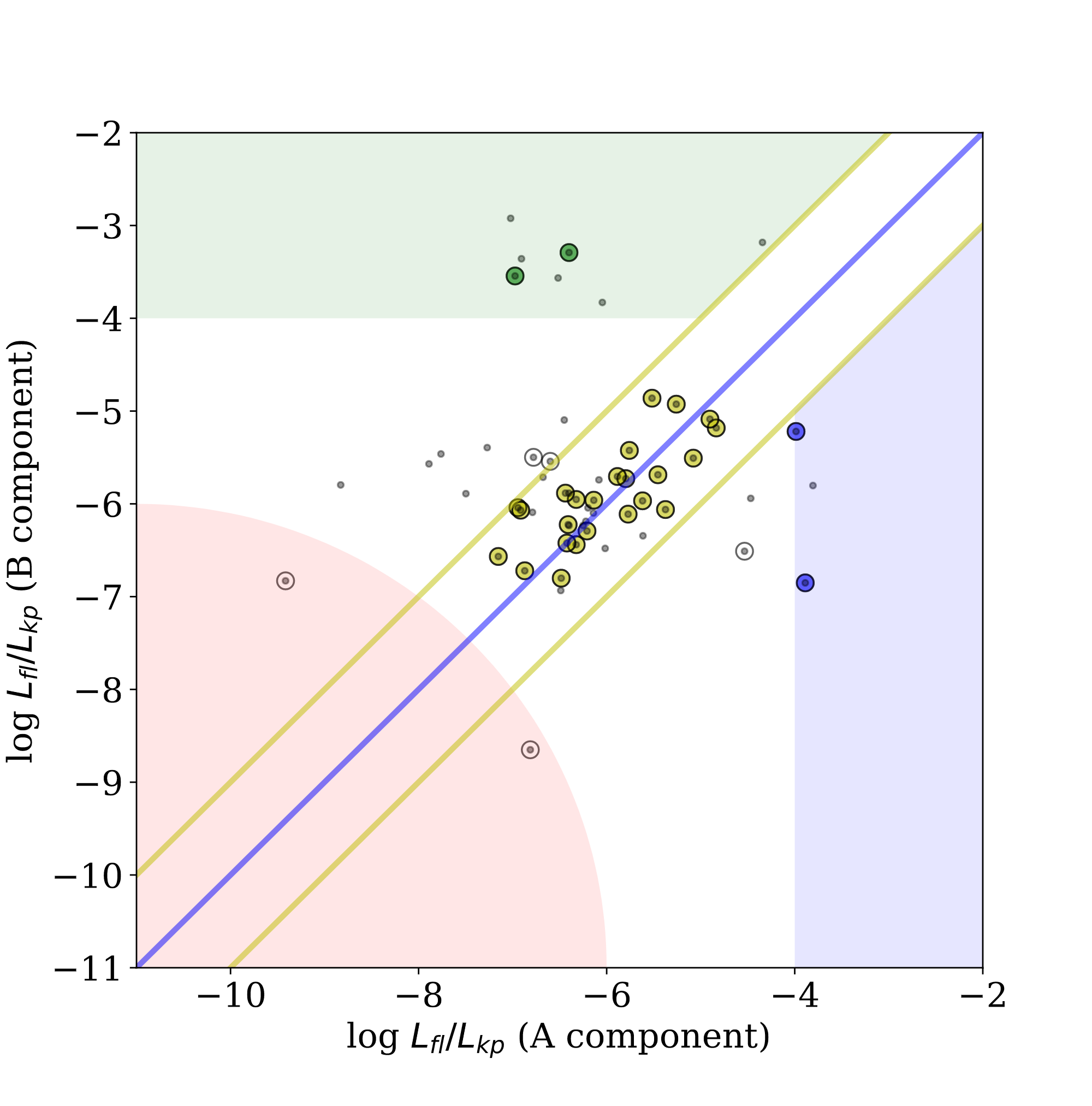
Component-wise relative flare luminosity comparison for 58 wide binaries with detected flare activity. The central blue line is the expected relationship for equal mass coeval components. The area between the yellow lines contains pairs whose difference in flare luminosity may plausibly be explained by a solar-like activity cycle. The green region contains pairs where the secondary star is significantly more active, while the blue region contains pairs where the primary is more active. The red region denotes the minimum flare detection threshold, below which flare signals are indistinguishable from noise. Circled points are pairs with mass ratio greater than 0.8, uncircled points are pairs with mass ratio less than 0.8.