Add JSON aggregate support for HasMany references #1286
There are no files selected for viewing
| Original file line number | Diff line number | Diff line change |
|---|---|---|
|
|
@@ -16,7 +16,7 @@ | |
| "oracle", | ||
| "postgresql" | ||
| ], | ||
| "version": "6.0.x-dev", | ||
| "authors": [ | ||
| { | ||
| "name": "Romans Malinovskis", | ||
|
|
||
| Original file line number | Diff line number | Diff line change |
|---|---|---|
|
|
@@ -6,6 +6,9 @@ | |
|
|
||
| /** | ||
| * Perform query operation on SQL server (such as select, insert, delete, etc). | ||
| * | ||
| * @method Expression fxJsonObject(array<string, Expressionable> $keyValuePairs) | ||
| * @method Expression jsonArrayAgg(Expressionable $expr) | ||
|
Member
There was a problem hiding this comment. This functionality has already #1268 PR but it is buggy on MySQL & MariaDB. In MariaDB it is a confirmed bug. In MySQL I did not investigate it in depth yet. Maybe it depends on configuration option. The PR should be merged first and we should not integrate it before MySQL/MariaDB is either fixed or we can always throw an error if and only if the bug is applicable. I see you are interested in HasMany To better understand your needs, what are your usecases for this PR?
Contributor
Author
There was a problem hiding this comment.
Well, good low-code design should have nice, short methods! :)
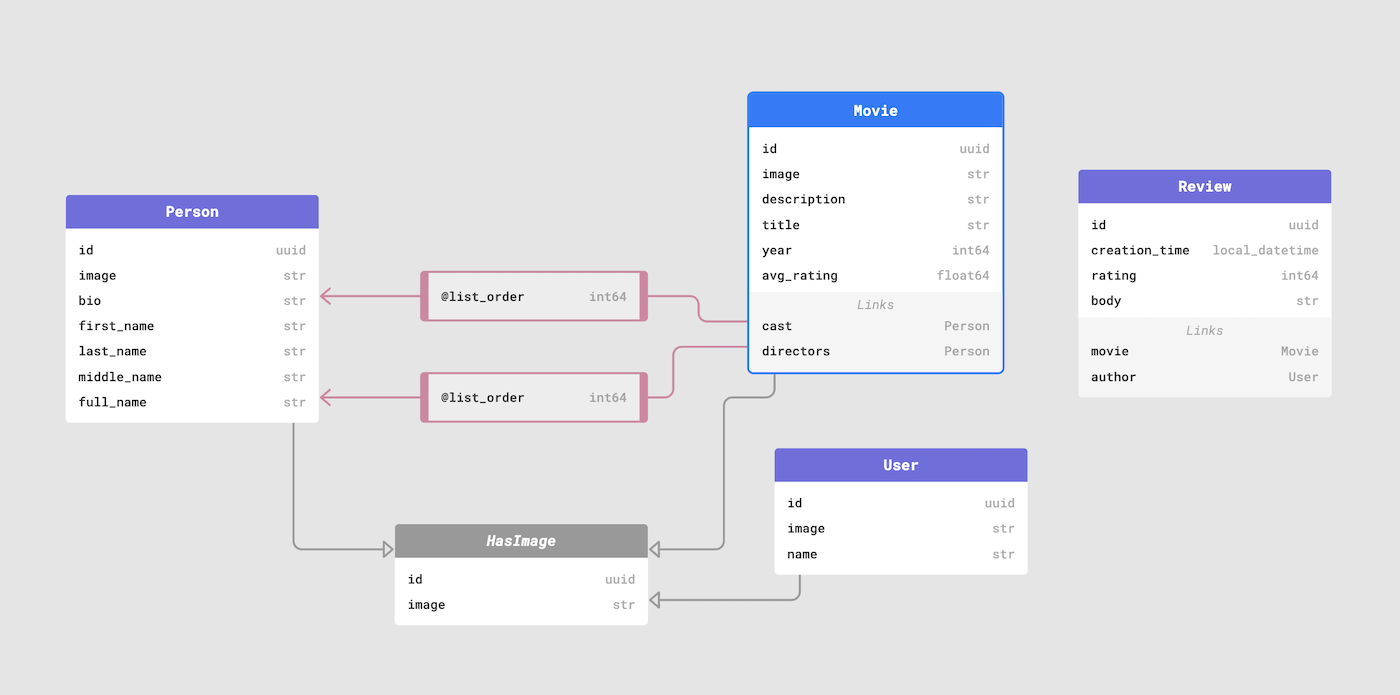
Example: movie database https://raw.githubusercontent.com/geldata/imdbench/master/docs/schema.png Task: Get data for a movie page
This is difficult or impossible to achieve without JSON aggregation. With this PR, I can accomplish this: class Movie extends \App\Core\Model {
protected function init(): void {
...
$this->hasMany('directors', ['model' => function ($persistence) {
$model = new Directors($persistence);
$model->join('person');
return $model;
}, 'theirField' => 'movie_id'])
->addField('directors_json', [
'aggregate' => 'json',
'fields' => [
'person.id',
'full_name' => fn($q, $r) => $q->expr('CONCAT([], CASE WHEN [] != "" THEN CONCAT(" ", []) ELSE "" END, " ", [])', [$r('person.first_name '), $r('person.middle_name'), $r('person.middle_name'), $r('person.last_name')]),
'person.image',
],
'type' => 'json',
]);
$this->hasMany('cast', ['model' => function ($persistence) {
$model = new Cast($persistence);
$model->join('person');
return $model;
}, 'theirField' => 'movie_id'])
->addField('cast_json', [
'aggregate' => 'json',
'fields' => [
'person.id',
'full_name' => fn($q, $r) => $q->expr('CONCAT([], CASE WHEN [] != "" THEN CONCAT(" ", []) ELSE "" END, " ", [])', [$r('person.first_name '), $r('person.middle_name'), $r('person.middle_name'), $r('person.last_name')]),
'person.image',
],
'type' => 'json',
]);
...
}
$movie = new Movie($persistence);
$movie = $movie->load($id);
return json_encode([
'id' => $movie->get('id'),
...
'directors' => $movie->get('directors_json') ?? [],
'cast' => $movie->get('cast_json') ?? [],
]);This example clearly shows why we need both JSON aggregation and dot notation working together. |
||
| */ | ||
| abstract class Query extends Expression | ||
| { | ||
|
|
||


| Original file line number | Diff line number | Diff line change |
|---|---|---|
|
|
@@ -8,6 +8,8 @@ | |
| use Atk4\Data\Exception; | ||
| use Atk4\Data\Field; | ||
| use Atk4\Data\Model; | ||
| use Atk4\Data\Model\Join; | ||
| use Atk4\Data\Persistence\Sql\Expressionable; | ||
| use Atk4\Data\Reference; | ||
|
|
||
| class HasMany extends Reference | ||
|
|
@@ -155,6 +157,90 @@ public function addField(string $fieldName, array $defaults = []): Field | |
| $fx = function () use ($defaults, $field) { | ||
| return $this->refLink()->action('fx0', [$defaults['aggregate'], $field]); | ||
| }; | ||
| } elseif ($defaults['aggregate'] === 'json') { | ||
|
Member
There was a problem hiding this comment.
|
||
| if (!isset($defaults['fields'])) { | ||
| throw new Exception('JSON aggregate requires "fields" parameter with array of field names'); | ||
| } | ||
|
|
||
| $jsonFields = $defaults['fields']; | ||
| unset($defaults['fields']); // Remove from field defaults | ||
|
|
||
| $fx = function () use ($jsonFields) { | ||
| $theirModel = $this->refLink(); | ||
| $query = $theirModel->action('select', [[]]); | ||
|
|
||
| // Helper to resolve field reference with dot notation support | ||
| $resolveField = static function ($fieldRef) use ($theirModel, $query) { | ||
| if (is_string($fieldRef) && str_contains($fieldRef, '.')) { | ||
| // Dot notation: 'join.field' - resolve from join | ||
| [$joinName, $fieldName] = explode('.', $fieldRef, 2); | ||
|
|
||
| // Find the join by iterating through model's joins | ||
| $join = null; | ||
| foreach ($theirModel->elements as $element) { | ||
| if ($element instanceof Join) { | ||
| if ($element->getForeignTable() === $joinName) { | ||
| $join = $element; | ||
|
|
||
| break; | ||
| } | ||
| } | ||
| } | ||
|
|
||
| if (!$join) { | ||
| throw (new Exception('Join not found for field reference')) | ||
| ->addMoreInfo('field', $fieldRef) | ||
| ->addMoreInfo('join', $joinName); | ||
| } | ||
|
|
||
| // Get field from join's foreign table | ||
| // The field is qualified as joinAlias.fieldName in the query | ||
| $joinAlias = $join->foreignAlias ?? ('_' . $joinName); | ||
|
|
||
| return $query->expr($joinAlias . '.' . $fieldName); | ||
| } | ||
|
|
||
| // Regular field reference | ||
| return $theirModel->getField($fieldRef); | ||
| }; | ||
|
|
||
| $jsonPairs = []; | ||
| foreach ($jsonFields as $key => $fieldSpec) { | ||
| // Determine output key name | ||
| if (is_int($key)) { | ||
| // No custom name - auto-generate from field spec | ||
| if (is_string($fieldSpec) && str_contains($fieldSpec, '.')) { | ||
| // Strip join prefix: 'person.first_name' -> 'first_name' | ||
| $jsonKey = explode('.', $fieldSpec, 2)[1]; | ||
| } else { | ||
| $jsonKey = is_string($fieldSpec) ? $fieldSpec : $key; | ||
| } | ||
| } else { | ||
| // Custom name provided | ||
| $jsonKey = $key; | ||
| } | ||
|
|
||
| if (is_string($fieldSpec)) { | ||
| $jsonPairs[$jsonKey] = $resolveField($fieldSpec); | ||
| } elseif ($fieldSpec instanceof Expressionable) { | ||
| $jsonPairs[$jsonKey] = $fieldSpec; | ||
| } elseif (is_callable($fieldSpec)) { | ||
| $jsonPairs[$jsonKey] = $fieldSpec($query, $resolveField); | ||
| } elseif (is_array($fieldSpec) && isset($fieldSpec['expr'])) { | ||
| if (is_callable($fieldSpec['expr'])) { | ||
| $jsonPairs[$jsonKey] = $fieldSpec['expr']($query, $resolveField); | ||
| } else { | ||
| $resolvedArgs = array_map($resolveField, $fieldSpec['args'] ?? []); | ||
| $jsonPairs[$jsonKey] = $query->expr($fieldSpec['expr'], $resolvedArgs); | ||
| } | ||
| } | ||
| } | ||
|
|
||
| $jsonObj = $query->fxJsonObject($jsonPairs); | ||
|
Member
There was a problem hiding this comment. This is legit usecase for a new method. See #1267 for non-associative PR. I would like to have this reviewed and merged separately. Please reuse as much as code from #1267 as possible. Like the non-object version, the object (associative) version should support MySQL 5.6, it should be possible to construct JSON string reliably without native JSON support. |
||
| $jsonAgg = $query->jsonArrayAgg($jsonObj); | ||
|
|
||
| return $theirModel->action('field', [$jsonAgg]); | ||
| }; | ||
| } else { | ||
| $fx = function () use ($defaults, $field) { | ||
| $args = [$defaults['aggregate'], $field]; | ||
|
|
||
There was a problem hiding this comment.
Choose a reason for hiding this comment
The reason will be displayed to describe this comment to others. Learn more.
revert