



Harden your Rust with specifications.
Anodized is a system that helps enforce complex specifications beyond Rust's built-in static analysis capabilities. In contrast to other systems, Anodized works on stable Rust and does not alter the language or the toolchain in any way. Going beyond that, Anodized makes it easy for static analysis tools to deeply integrate with Rust without duplicating parts of the language or the toolchain.
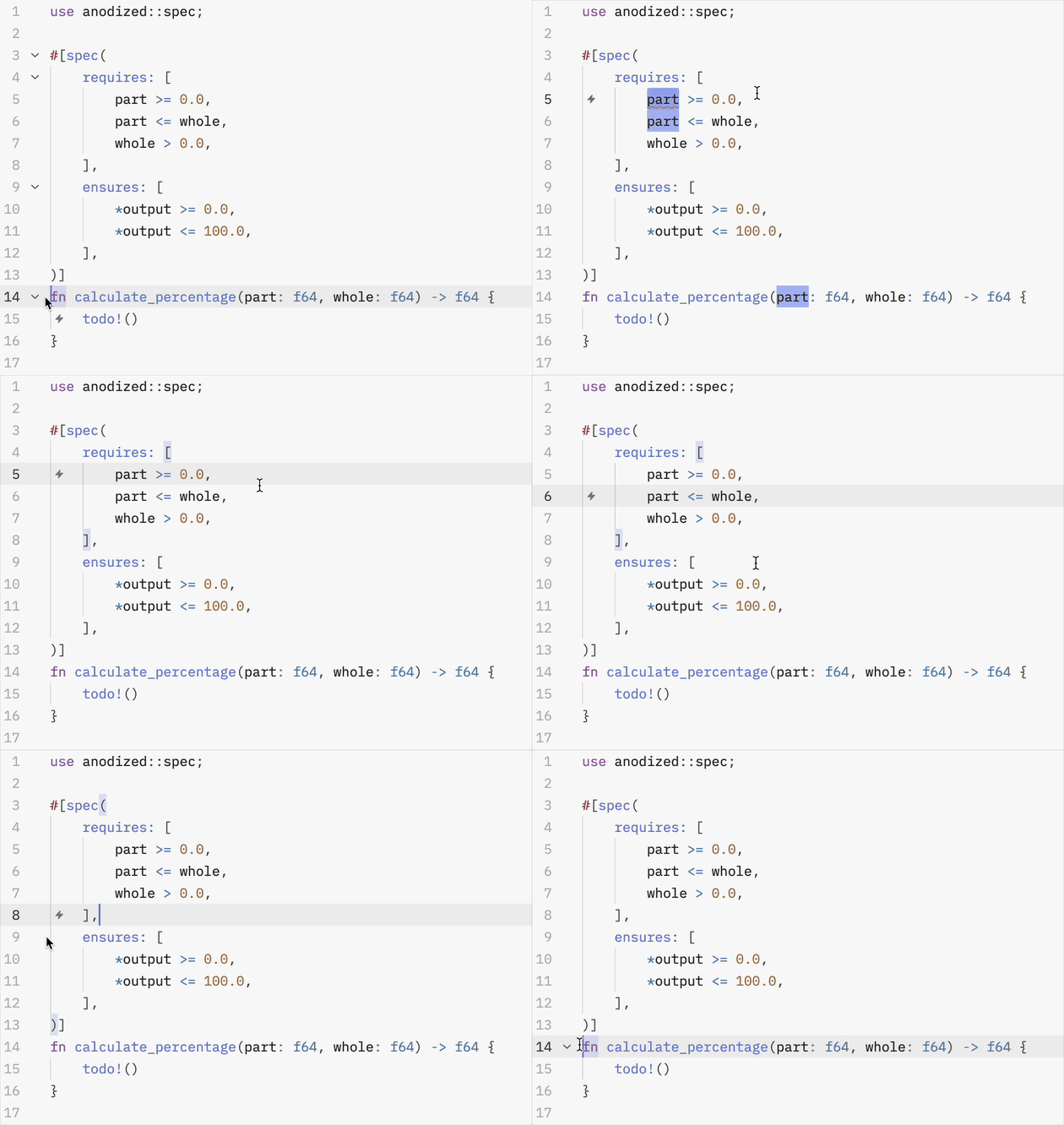
- expressive: Write preconditions, postconditions, and invariants as ordinary Rust expressions.
- integrated: Parsed and validated on every build, even with runtime checks disabled.
- automated: Runtime checks out of the box, with fuzzing and static analysis on the roadmap.
Anodized spec Annotations vs Comments, Assertions, and Types
| Anodized | Comments | Assertions | Types | |
|---|---|---|---|---|
| Expressivity | High | Highest | High | Low |
| Validated | Yes | No | Yes | Yes |
| Centralized | Yes | No | No | Yes |
| Tool-Ready | Yes | No | No | No |
Anodized is to verification what serde is to serialization.
The Rust Team is building native contract support into the language. We hope that learnings from Anodized will help their work, and we plan to offer a migration tool so that Anodized users can switch to Rust-native contracts as soon as they're ready.
Rust has many excellent verification tools (Aeneas, Creusot, Flux, Kani, Prusti, Verus, and more), but they all suffer from the following issues that stand in the way of widespread adoption:
- They change Rust (the language or the toolchain) in non-trivial ways, making them more effort to maintain and use.
- Keeping the modified components in sync with upstream Rust is a lot of effort that slows down development.
- They are largely incompatible with one another due to the different changes they each make to Rust.
Anodized aims to help other systems become easier to maintain and use by solving those problems. Developers of verification systems can focus on the analysis itself and avoid duplicating the effort of defining and processing specifications. Users can write their specifications once, and gain access to a wide range of capabilities including runtime checks, fuzzing, static analysis, and more.
How Anodized's Goals Are Different
| System | Language | Toolchain | Static | Runtime | API | Focus |
|---|---|---|---|---|---|---|
| Anodized | Standard | Stable | Yes | Yes | Yes | Interoperability |
| Aeneas | Modified | Custom | Yes | No | Yes | Static Analysis |
contracts |
Modified | Stable | No | Yes | No | Runtime Checks |
| Creusot | Modified | Custom | Yes | No | No | Static Analysis |
| Flux | Modified | Nightly | Yes | No | No | Refinement Types |
| Kani | Modified | Custom | Yes | No | No | Static Analysis |
| Prusti | Modified | Nightly | Yes | No | No | Static Analysis |
| Verus | Modified | Custom | Yes | No | No | Static Analysis |
Anodized aims to become a common layer across runtime checks, fuzzing, and verification.
#[spec] Support
| Program Element | Status | Notes |
|---|---|---|
plain fn |
Available | Pre- and postconditions, invariants. |
fn inside an impl |
Available | Pre- and postconditions, invariants. |
trait and its fns |
In Progress | Enforces all impls to conform. |
struct, enum |
Planned | Data invariants. |
while, loop, for |
Planned | Loop invariants. |
Runtime Behaviors
| Behavior | Status | A spec violation... |
|---|---|---|
check-and-panic |
Available | panics |
check-and-print |
Available | prints an error |
no-check |
Available | has no runtime effect |
check-and-log |
Planned | writes to a log |
check-and-trace |
Planned | emits a trace event |
check-and-trap |
Planned | breaks into a debugger |
Analyzer Integrations
| System | Status | Notes |
|---|---|---|
| Aeneas | Planned | Integrate with Charon |
| Creusot | Planned | |
| Flux | Planned | |
| Kani | Planned | |
| Prusti | Planned | |
| Verus | Planned | Emit VIR |
1. Add Anodized to your project.
[dependencies]
anodized = "0.3.0"
2. Add specifications to your functions.
Use the #[spec] attribute to define preconditions (requires), postconditions (ensures), and invariants (maintains). Each condition is a standard Rust expression that evaluates to bool. In postconditions, the function's return value is available as output.
use anodized::spec;

#[spec(
    requires: [
        part >= 0.0,
        part <= whole,
        whole > 0.0,
    ],
    ensures: [
        *output >= 0.0,
        *output <= 100.0,
    ],
)]
fn calculate_percentage(part: f64, whole: f64) -> f64 {
    100.0 * part / whole
}

fn main() {
    // This call satisfies the spec and runs fine.
    println!("25 out of 100 = {}%", calculate_percentage(25.0, 100.0));

    // This call violates the precondition and will panic.
    println!("10 out of 0 = {}%", calculate_percentage(10.0, 0.0));
}
3. Run or test your code as usual.
Your code is automatically instrumented to check the specifications at runtime. A spec violation will cause a panic with a descriptive error message:
thread 'main' panicked at 'Precondition failed: whole > 0', src/main.rs:17:5
By default, runtime spec-checking is always active (just like Rust's assert! macro). For performance-sensitive code, you can use #[cfg] attributes to control when checks run (see the #[cfg] section below).
Important: Even when a condition's runtime check is disabled via a #[cfg] build setting, the compiler still validates that condition at compile time for syntax errors, unknown identifiers, type mismatches, etc.
The #[spec] attribute provides a powerful and ergonomic way to define specifications.
Specifications are built from conditions, which come in three flavors:
-
requires: <conditions>: Preconditions must be true when the function is called. -
ensures: <conditions>: Postconditions must be true when the function returns. -
maintains: <conditions>: Invariants must hold true both before and after the function runs. It's most useful for expressing properties ofselfthat a method must preserve.
For convenience, <conditions> can be either a single condition or a list (i.e. [<condition>, <condition>, ...]).
The conditions must be given in the following order: requires, maintains, and ensures. This order is enforced to mirror the logical flow of a function's execution: preconditions (requires) are checked upon entry, invariants (maintains) must hold true upon both entry and exit, and postconditions (ensures) are checked upon exit.
A condition is a bool-valued Rust expression; as simple as that. This is a non-trivial design choice, so its benefits are explained in the section below: Why Conditions Are Rust Expressions.
You can include any number of each flavor. Multiple conditions of the same flavor are combined with a logical AND (&&).
use anodized::spec;

#[spec(
    // Precondition: the vector must have room for at least one more element
    requires: vec.len() < vec.capacity() || vec.capacity() == 0,
    // Invariant: length never exceeds capacity
    maintains: vec.len() <= vec.capacity(),
)]
fn push_checked<T>(vec: &mut Vec<T>, value: T) { todo!() }Anodized offers multiple runtime behaviors that control how #[spec] annotations expand to runtime checks:
check-and-panic: Inject anassert!check for eachrequires,maintains, andensuresclause. A failing condition panics with a descriptive message, just like the examples above.check-and-print: Reports violations witheprintln!so execution can continue. Useful for experiments, logging, etc.no-check: Disable checks altogether. Each check is surrounded with anif false { ... }, which lets the compiler optimize the checks away, while keeping the#[spec]syntax- and type-checked.
The runtime setting goes in your Cargo.toml, for example:
anodized = {
  version = # version
  features = ["runtime-check-and-print"]
}
Future runtime behaviors (log, trace, breakpoint, etc.) will use the same feature-based mechanism.
By default, each condition is checked at runtime, just like Rust's assert! macro: it's always active in both debug and release builds. You can use the standard #[cfg] attribute to select build configurations under which the runtime check is active.
use anodized::spec;

#[spec(
    // Runtime checks only during `cargo test`.
    #[cfg(test)]
    requires: input > 0,

    // Runtime checks only in debug builds (like `debug_assert!`)
    #[cfg(debug_assertions)]
    ensures: output.is_ok(),
)]
fn perform_complex_operation(input: i32) -> Result<i32, String> { todo!() }
The #[cfg] attribute follows standard Rust semantics: when the configuration predicate is false, the runtime check for the condition is completely omitted. Without a #[cfg] attribute, the condition behaves exactly like assert!, always checked at runtime.
Important: Anodized guarantees that each condition remains syntactically valid and type-correct regardless of its #[cfg] settings. This prevents conditions from becoming invalid between different build configurations, and keeps the entire spec always visible to analysis tools.
Common Patterns:
#[cfg(debug_assertions)]: Check only in debug builds (likedebug_assert!).#[cfg(test)]: Check only during testing.- No
#[cfg]: Always check (likeassert!).
Sometimes postconditions need to compare the function's final state with its initial state. The captures parameter lets you capture values at function entry for use in postconditions.
use anodized::spec;

#[spec(
    captures: [
        // Copy types: captured directly
        items.len() as orig_len,
        // Non-Copy types: use .clone() explicitly
        items.clone() as orig_items,
    ],
    ensures: [
        items.len() == orig_len + 1,
        items[0] == orig_items[0],
    ],
)]
fn add_item<T: Clone + Eq>(items: &mut Vec<T>, item: T) { todo!() }- Simple identifiers get an automatic
old_prefix, i.e.xbecomesold_x. - Complex expressions require an explicit alias using
as, i.e.self.items.len() as orig_len. - No automatic cloning: Each captured expression is moved. For a
Copytype, a copy is made implicitly. For a non-Copytype, you must explicitly use.clone(),.to_owned(), or another appropriate method. - Capturing happens after preconditions are checked but before the function body executes.
- The captured values are only available to postconditions, not to preconditions or the function body itself.
In postconditions (ensures), you can refer to the function's return value by the default name output.
use anodized::spec;

#[spec(
    ensures: *output > 0,
)]
fn get_positive_value() -> i32 { todo!() }
Note that a postcondition is a closure that takes the function's return value by reference. When you write a postcondition as a "naked" expression <EXPR>, that is shorthand for |<PATTERN>| <EXPR>, where <PATTERN> is the spec-wide binding. In error messages, a postcondition is always displayed as a closure to make it clear (e.g. | output | *output > 0).
The default spec-wide binding is output. If that collides with an existing identifier, you can choose a different name for it in two ways:
1. Spec-Wide Binding: Use the binds parameter to set a new name for the return value across all postconditions in the specification. It must be placed immediately before any ensures conditions.
use anodized::spec;

#[spec(
    binds: new_value,
    ensures: *new_value > old_value,
)]
fn increment(old_value: i32) -> i32 { todo!() }
2. Explicit Binding: Write the postcondition with an explicit binding, i.e. as a closure |<PATTERN>| <EXPR>. This has the highest precedence and affects only that single condition.
use anodized::spec;

#[spec(
    ensures: [
        // This postcondition uses the default binding.
        output.is_ascii(),
        // This postcondition binds the output as `c`.
        |c| c.is_digit(16),
    ],
)]
fn create_data() -> char { todo!() }
3. Binding Precedence: The explicit binding takes precedence; same as in Rust. Plain postconditions still use the spec-wide binding.
use anodized::spec;

// A function where 'output' is an argument name, requiring a different name.
#[spec(
    // Set a spec-wide binding for the return value: `result`.
    binds: result,
    ensures: [
        // This postcondition uses the spec-wide binding: `result`.
        *result > output,
        // This postcondition uses an explicit binding: `val`.
        |val| *val % 2 == 0,
    ],
)]
fn calculate_even_result(output: i32) -> i32 { todo!() }
4. Beyond Names: Destructuring Return Values
Bindings also lets you destructure return values, making complex postconditions easier to read and write. You can use any valid Rust pattern, including tuple patterns, struct patterns, or even more complex nested patterns.
use anodized::spec;

#[spec(
    // Destructure the returned tuple into `(a, b)`.
    binds: (a, b),
    // Postconditions can now use the bound variables `a` and `b`.
    ensures: [
        a <= b,
        // They can also reference the arguments.
        (*a, *b) == pair || (*b, *a) == pair,
    ],
)]
fn sort_pair(pair: (i32, i32)) -> (i32, i32) { todo!() }use anodized::spec;
#[spec(
requires: *balance >= amount,
maintains: *balance >= 0,
captures: *balance as initial_balance,
binds: (new_balance, receipt_amount),
ensures: [
*new_balance == initial_balance - amount,
*receipt_amount == amount,
*balance == *new_balance,
],
)]
fn withdraw(balance: &mut u64, amount: u64) -> (u64, u64) { todo!() }A core design principle of Anodized is that a condition is written as a standard Rust expression that evaluates to bool. This is a deliberate choice that provides key benefits over using a custom language.
-
The Language You Already Know: No need to learn yet another language to write the conditions. Write them in the one you already know: standard Rust. Call functions, use macros (like
matches!), or writeifandmatchexpressions, and so on. As long as it all evaluates to abool, it's good to go. -
An Integral Part of Your Code: Conditions aren't special comments or strings; they are real Rust expressions, fully integrated with your code. The Rust compiler checks every condition for syntax and type errors, just like any other part of your code. If you misspell a variable, compare incompatible types, or make any other mistake, you'll get a familiar compiler error pointing directly to the condition that needs fixing.
The choice of "specification" (or "spec") over "contract" is deliberate. While Design by Contract has a rich history, the term "contract" is now strongly associated with blockchain. This is particularly true in Rust, which has become a leading language for smart contract development.
This naming collision hurts discoverability. Searching for "Rust contract" yields blockchain results, not correctness tools.
Using "specification" instead:
- Improves discoverability: Developers find correctness tools when searching for them.
- Reduces confusion: The distinction from blockchain is immediately clear.
- Maintains clarity: "Specification" accurately describes these formal behavior annotations.
The term "spec" is already familiar from test specs, API specs, and formal specifications. It conveys the same meaning as Design by Contract while avoiding modern ambiguity.
The idea of adding contracts to Rust isn't new, and Anodized builds upon the great work and ideas from several other projects and discussions in the community. It is a fresh take with a strong focus on ergonomics and a forward-looking vision for an integrated ecosystem.
The contracts Crate
The most direct and popular predecessor is the contracts crate. It is a mature and feature-rich library that also provides #[requires], #[ensures], and #[invariant] attributes. It has been a major inspiration for Anodized.
Anodized differentiates itself with a few key design choices:
-
Unified Attribute: Anodized uses a single, comprehensive
#[spec]attribute to group all conditions for a function, presenting the entire specification as one cohesive block. -
Ergonomic Focus: The design process has been heavily focused on refining the user-facing syntax (e.g. keyword choices, return value binding) to be as intuitive, approachable, and powerful as possible.
-
Ecosystem Vision: While
contractsis an excellent tool for runtime checking, Anodized is designed from the ground up to be a foundational layer for a wider ecosystem of diverse correctness tools, from fuzzing to formal verification.
Other Crates
Older crates like libhoare (a compiler plugin from before procedural macros were stabilized) and dbc explored similar ideas, proving the long-standing interest in Design by Contract within the Rust community. Anodized benefits from the modern procedural macro system, which allows for much better integration with the compiler and toolchain.
Inspiration from Other Languages
Anodized is also inspired by languages where contracts are a first-class feature, not just a library. Languages like Whiley, Eiffel, and Ada/SPARK demonstrate the power of deeply integrating formal specifications into the syntax, type system, and toolchain. The Anodized ecosystem begins with one library, but shares the great ambition of those languages: to bring a similar level of integration and ergonomic feel to Rust.
Anodized is distributed under the terms of the MIT License and the Apache License (Version 2.0). Users can choose either license, and contributors must license their changes under both.
See LICENSE-MIT and LICENSE-APACHE for details.
Contributions are welcome! Please feel free to open an issue or submit a pull request.
For detailed technical documentation including the formal specification grammar and runtime check implementation details, see the anodized-core documentation.