

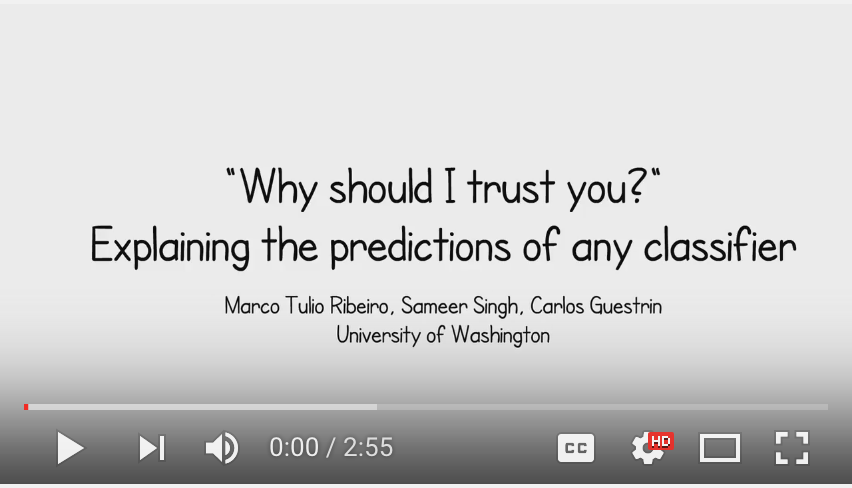
This project is about explaining what machine learning classifiers (or models) are doing. At the moment, we support explaining individual predictions for text classifiers or classifiers that act on tables (numpy arrays of numerical or categorical data) or images, with a package called lime (short for local interpretable model-agnostic explanations). Lime is based on the work presented in this paper (bibtex here for citation). Here is a link to the promo video:
Our plan is to add more packages that help users understand and interact meaningfully with machine learning.
Lime is able to explain any black box classifier, with two or more classes. All we require is that the classifier implements a function that takes in raw text or a numpy array and outputs a probability for each class. Support for scikit-learn classifiers is built-in.
The lime package is on PyPI. Simply run:
pip install limeOr clone the repository and run:
pip install .We dropped python2 support in 0.2.0, 0.1.1.37 was the last version before that.
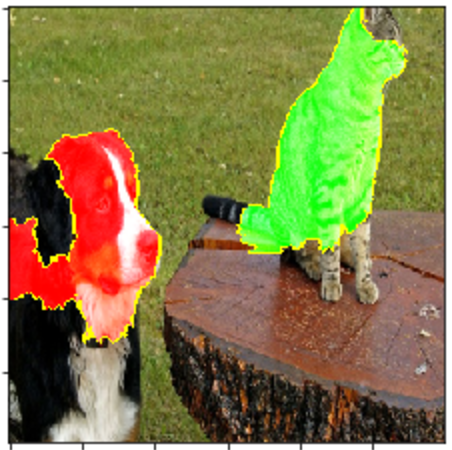
Below are some screenshots of lime explanations. These are generated in html, and can be easily produced and embedded in ipython notebooks. We also support visualizations using matplotlib, although they don't look as nice as these ones.
Negative (blue) words indicate atheism, while positive (orange) words indicate christian. The way to interpret the weights by applying them to the prediction probabilities. For example, if we remove the words Host and NNTP from the document, we expect the classifier to predict atheism with probability 0.58 - 0.14 - 0.11 = 0.31.


For example usage for text classifiers, take a look at the following two tutorials (generated from ipython notebooks):
For classifiers that use numerical or categorical data, take a look at the following tutorial (this is newer, so please let me know if you find something wrong):
For image classifiers:
For regression:
Submodular Pick:
The raw (non-html) notebooks for these tutorials are available here.
The API reference is available here.
For Japanese (lang='jp') tokenization, this fork uses Sudachi to avoid external MeCab/UniDic setup.
- Install SudachiPy:
pip install sudachipy
- Install a dictionary (if not already bundled via your Sudachi distribution):
- Core dictionary:
pip install sudachidict_core
- Core dictionary:
- Usage:
explainer = LimeTextExplainer(lang='jp')will use Sudachi-backed splitter automatically.
Notes:
- The tokenizer is instantiated once (singleton) for performance.
- If Sudachi is not installed,
LimeTextExplainer(lang='jp')will raise an ImportError with instructions. - A minimal character-based fallback exists in
lime.japanese.splitters.mecab_unidic_splitto keep basic tests runnable without Sudachi, but production usage should install Sudachi.
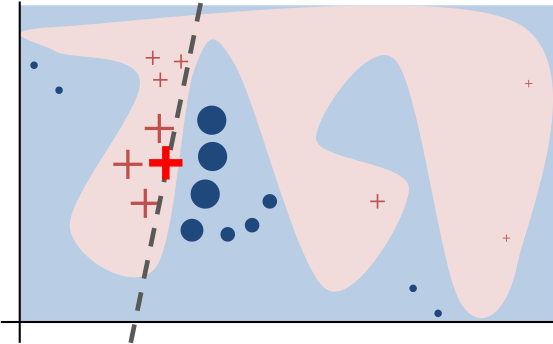
Intuitively, an explanation is a local linear approximation of the model's behaviour. While the model may be very complex globally, it is easier to approximate it around the vicinity of a particular instance. While treating the model as a black box, we perturb the instance we want to explain and learn a sparse linear model around it, as an explanation. The figure below illustrates the intuition for this procedure. The model's decision function is represented by the blue/pink background, and is clearly nonlinear. The bright red cross is the instance being explained (let's call it X). We sample instances around X, and weight them according to their proximity to X (weight here is indicated by size). We then learn a linear model (dashed line) that approximates the model well in the vicinity of X, but not necessarily globally. For more information, read our paper, or take a look at this blog post.
Please read this.