







af-analysis is a python package for the analysis of AlphaFold protein structure predictions.
This package is designed to simplify and streamline the process of working with protein structures
generated by:
Source code repository: https://github.com/samuelmurail/af_analysis
AlphaFold 2 and its derivatives have revolutionized protein structure prediction, achieving remarkable accuracy.
Analyzing the abundance of resulting structural models can be challenging and time-consuming.
Existing tools often require separate scripts for calculating various quality metrics (pDockQ, pDockQ2, LIS score) and assessing model diversity.
af-analysis addresses these challenges by providing a unified and user-friendly framework for in-depth analysis of AlphaFold 2 results.
- Import AlphaFold or ColabFold prediction directories as pandas DataFrames for efficient data handling.
- Calculate and add additional structural quality metrics to the DataFrame, including:
- pDockQ
- pDockQ2
- LIS score (cLIS and iLIS scores)
- ipSAE (and the ipTM matrix derived from PAE)
- Visualize predicted protein models.
- Cluster generated models to identify diverse conformations.
- Select the best models based on defined criteria.
- Add your custom metrics to the DataFrame for further analysis.
af-analysisis available on PyPI and can be installed usingpip:
pip install af_analysis- You can install last version from the github repo:
pip install git+https://github.com/samuelmurail/af_analysis.git@main- AF-Analysis can also be installed easily through github:
git clone https://github.com/samuelmurail/af_analysis
cd af_analysis
pip install .- For developers, you can install the package in editable mode:
git clone https://github.com/samuelmurail/af_analysis
cd af_analysis
pip install -e .A conda environment file is provided to create an environment with all dependencies:
conda env create -f environment.yml
conda activate af_analysisThe complete documentation is available at ReadTheDocs.
-
A notebook showing the basic usage of the
af_analysislibrary can be found here. -
Alternatively you can test is directly on Google colab:
Create the Data object, giving the path of the directory containing the results of the alphafold2/colabfold run.
import af_analysis
my_data = af_analysis.Data('MY_AF_RESULTS_DIR')
In most cases, the Data object will automatically detect the format of the results (AlphaFold 2, AlphaFold 3, ColabFold). If needed, you can specify the format using the format argument:
my_data = af_analysis.Data('MY_AF_RESULTS_DIR', format='afpulldown')Extracted data are available in the df attribute of the Data object.
my_data.dffrom af_analysis import analysis
analysis.pdockq(my_data)
analysis.pdockq2(my_data)from af_analysis import docking
docking.LIS_pep(my_data)
docking.ipSAE(my_data)- At first approach the user can visualize the pLDDT, PAE matrix and the model scores. The
show_info()function displays the scores of the models, as well as the pLDDT plot and PAE matrix in a interactive way.
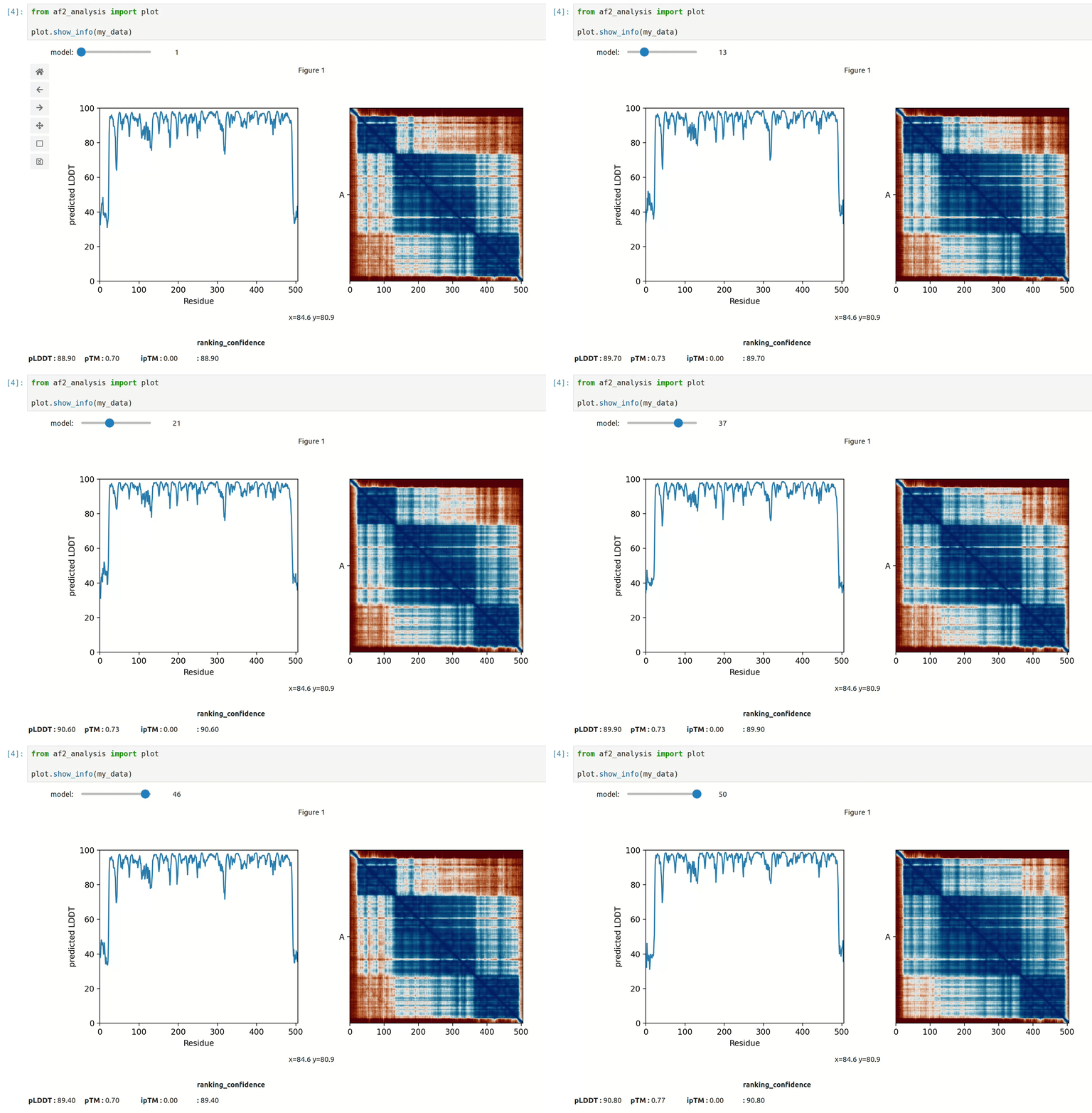
- plot msa, plddt and PAE:
my_data.plot_msa()
my_data.plot_plddt([0,1])
best_model_index = my_data.df['ranking_confidence'].idxmax()
my_data.plot_pae(best_model_index)- show 3D structure (
nglviewpackage required):
my_data.show_3d(my_data.df['ranking_confidence'].idxmax())af_analysis requires the following dependencies:
pdb_numpypandasnumpytqdmseaborncmcrameringlviewipywidgetsmdanalysis
af-analysis is an open-source project and contributions are welcome. If
you find a bug or have a feature request, please open an issue on the GitHub
repository at https://github.com/samuelmurail/af_analysis. If you would like
to contribute code, please fork the repository and submit a pull request.
- Alaa Regei, Graduate Student - Université Paris Cité.
- Samuel Murail, Associate Professor - Université Paris Cité, CMPLI, RPBS platform.
See also the list of contributors who participated in this project.
To release a new version of the package, follow these steps:
- Commit the changes and push to GitHub:
git add .
git commit -m "Update of ..."
git push origin main- Update the version number in using bump-my-version:
bump-my-version bump <part>where <part> is one of major, minor, or patch depending on the type of release.
- Commit the changes and push to GitHub:
git add .
git commit -m "Bump version to x.y.z"
git push origin main- Create the pypi package and upload it:
make releaseRemember that a valid .pypirc file must be present in your home directory with the correct credentials.
If you use the code of this package, please cite:
- Reguei A and Murail S. Af-analysis: a Python package for Alphafold analysis.
Journal of Open Source Software (2025) doi: 10.21105/joss.07577
@Article{reguei_af-analysis_2025,
	title = {Af-analysis: a {Python} package for {Alphafold} analysis},
	volume = {10},
	issn = {2475-9066},
	shorttitle = {Af-analysis},
	url = {https://joss.theoj.org/papers/10.21105/joss.07577},
	doi = {10.21105/joss.07577},
	language = {en},
	number = {107},
	urldate = {2025-03-14},
	journal = {Journal of Open Source Software},
	author = {Reguei, Alaa and Murail, Samuel},
	month = mar,
	year = {2025},
	pages = {7577},
}This project is licensed under the GNU General Public License version 2 - see the LICENSE file for details.
- Jumper et al. Nature (2021) doi: 10.1038/s41586-021-03819-2
- Abramson et al. Nature (2024) doi: 10.1038/s41586-024-07487-w
- Mirdita et al. Nature Methods (2022) doi: 10.1038/s41592-022-01488-1
- Evans et al. bioRxiv (2021) doi: 10.1101/2021.10.04.463034
- Bryant et al. Nat. Commun. (2022) doi: 10.1038/s41467-022-28865-w
- Zhu et al. Bioinformatics (2023) doi: 10.1093/bioinformatics/btad424
- Kim et al. bioRxiv (2024) doi: 10.1101/2024.02.19.580970
- Yu et al. Bioinformatics (2023) doi: 10.1093/bioinformatics/btac749
- Wohlwend et al. bioRxiv (2024) doi: 10.1101/2024.11.19.624167
- Chai Discovery et al. bioRxiv (2024) doi:10.1101/2024.10.10.615955v2
- MassiveFold Raouraoua et al. Nat. Comput. Sci. (2024) doi:10.1038/s43588-024-00714-4
- Dunbrack. Biorxiv (2025) doi: 10.1101/2025.02.10.637595