
Accelerating Reproducible Mahjong Research





Note
While RiichiEnv is being built with reinforcement learning applications in mind, it is still very much a work in progress. As indicated in our Milestones, we haven't yet completed the optimization or verification necessary for RL contexts. The API and specifications are subject to change before the stable release.
- High Performance: Core logic implemented in Rust for lightning-fast state transitions and rollouts.
- Gym-style API: Intuitive interface designed specifically for reinforcement learning.
- Mortal Compatibility: Seamlessly interface with the Mortal Bot using the standard MJAI protocol.
- Rule Flexibility: Support for diverse rule sets, including no-red-dragon variants and three-player mahjong.
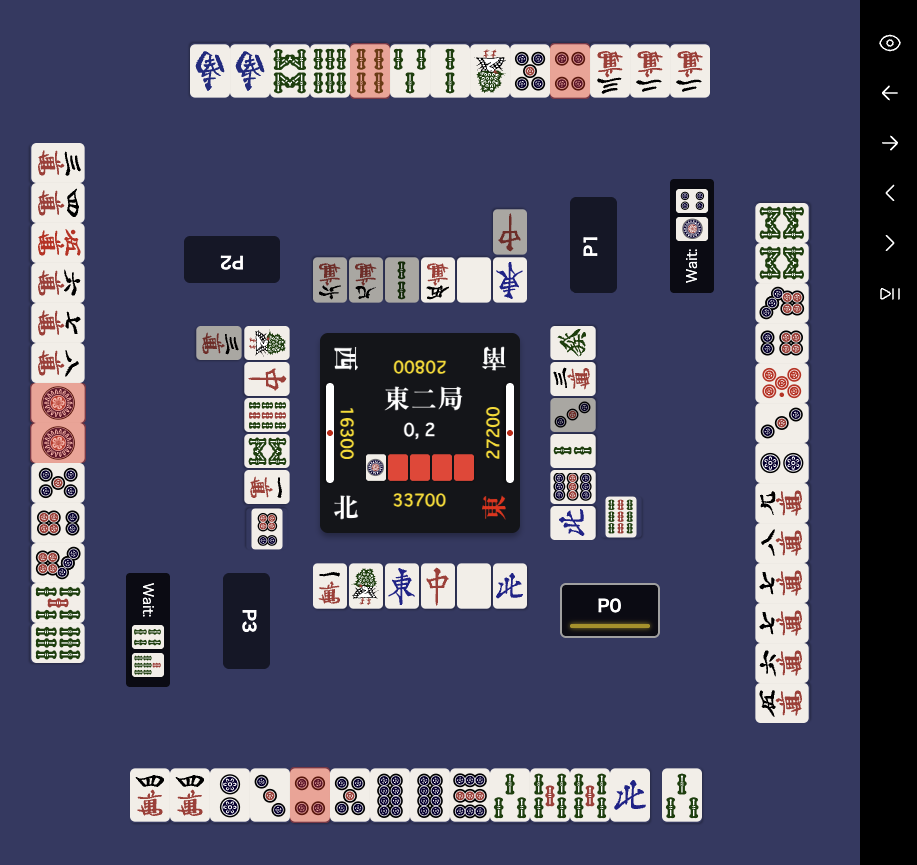
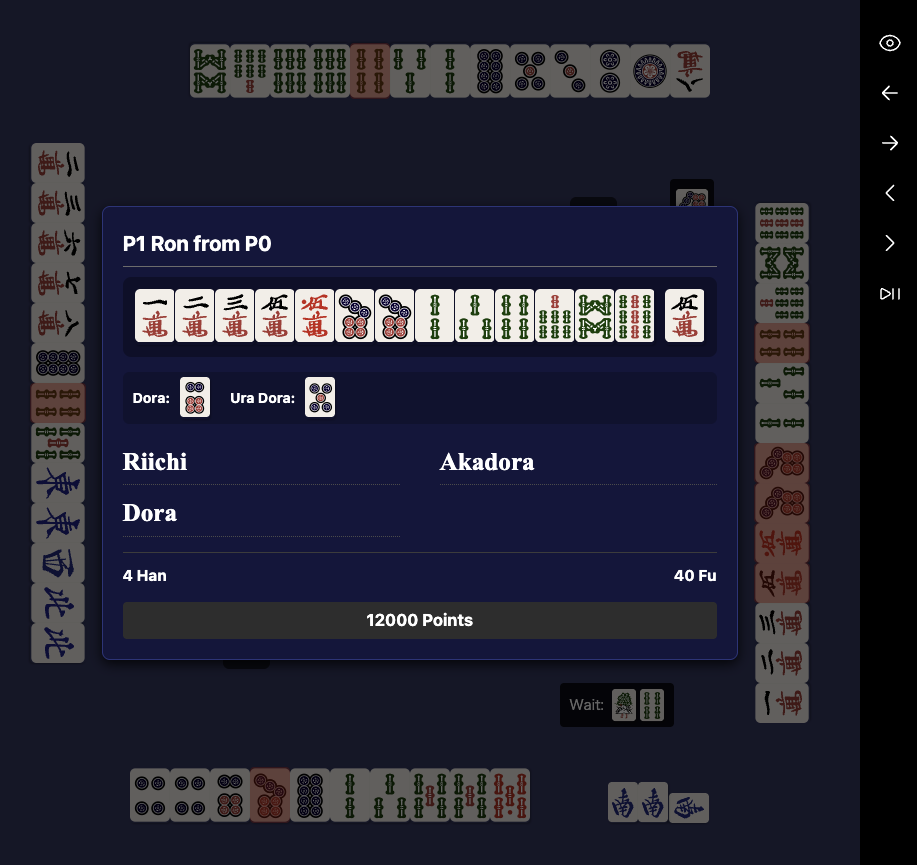
- Game Visualization: Integrated replay viewer for Jupyter Notebooks.
uv add riichienv
# Or
pip install riichienv
Currently, building from source requires the Rust toolchain.
uv sync --dev
uv run maturin develop --releasefrom riichienv import RiichiEnv
from riichienv.agents import RandomAgent
agent = RandomAgent()
env = RiichiEnv()
obs_dict = env.reset()
while not env.done():
actions = {player_id: agent.act(obs)
for player_id, obs in obs_dict.items()}
obs_dict = env.step(actions)
scores, points, ranks = env.scores(), env.points(), env.ranks()
print(scores, points, ranks)env.reset() initializes the game state and returns the initial observations. The returned obs_dict maps each active player ID to their respective Observation object.
>>> from riichienv import RiichiEnv
>>> env = RiichiEnv()
>>> obs_dict = env.reset()
>>> obs_dict
{0: <riichienv._riichienv.Observation object at 0x7fae7e52b6e0>}
Use env.done() to check if the game has concluded.
>>> env.done()
False
By default, the environment runs a single round (kyoku). For game rules supporting sudden death or standard match formats like East-only or Half-round, the environment continues until the game-end conditions are met.
The Observation object provides all relevant information to a player, including the current game state and available legal actions.
obs.new_events() -> list[str] returns a list of new events since the last step, encoded as JSON strings in the MJAI protocol. The full history of events is accessible via obs.events.
>>> obs = obs_dict[0]
>>> obs.new_events()
['{"id":0,"type":"start_game"}', '{"bakaze":"E","dora_marker":"S", ...}', '{"actor":0,"pai":"6p","type":"tsumo"}']
obs.legal_actions() -> list[Action] provides the list of all valid moves the player can make.
>>> obs.legal_actions()
[Action(action_type=Discard, tile=Some(1), ...), ...]
If your agent communicates via the MJAI protocol, you can easily map an MJAI response to a valid Action object using obs.select_action_from_mjai().
>>> obs.select_action_from_mjai({"type":"dahai","pai":"1m","tsumogiri":False,"actor":0})
Action(action_type=Discard, tile=Some(1), consume_tiles=[])RiichiEnv is fully compatible with the Mortal MJAI bot processing flow. I have confirmed that MortalAgent can execute matches without errors in over 1,000,000+ hanchan games on RiichiEnv.
from riichienv import RiichiEnv, Action
from model import load_model

class MortalAgent:
    def __init__(self, player_id: int):
        self.player_id = player_id
        # Initialize your libriichi.mjai.Bot or equivalent
        self.model = load_model(player_id, "./mortal_v4.pth")

    def act(self, obs) -> Action:
        resp = None
        for event in obs.new_events():
            resp = self.model.react(event)

        action = obs.select_action_from_mjai(resp)
        assert action is not None, "Mortal must return a legal action"
        return action

env = RiichiEnv(game_mode="4p-red-half")
agents = {pid: MortalAgent(pid) for pid in range(4)}
obs_dict = env.reset()
while not env.done():
    actions = {pid: agents[pid].act(obs) for pid, obs in obs_dict.items()}
    obs_dict = env.step(actions)

print(env.scores(), env.points(), env.ranks())RiichiEnv separates high-level game flow configuration (Mode) from detailed game mechanics (Rules).
- Game Mode (
game_mode): Configuration for game length (e.g., East-only, Hanchan), player count, and termination conditions (e.g., Tobi/bust, sudden death). - Game Rules (
rule): Configuration for specific game mechanics (e.g., handling of Chankan (Robbing the Kan) for Kokushi Musou, Kuitan availability, etc.).
You can select a standard game mode using the game_mode argument in the constructor. This configures the basic flow of the game.
game_mode |
Players | Mode | Mechanics |
|---|---|---|---|
4p-red-single |
4 | Single Round | No sudden death |
4p-red-east |
4 | East-only (東風; Tonpuu) | Standard (Tenhou rule) |
4p-red-half |
4 | Hanchan (半荘) | Standard (Tenhou rule) |
3p-red-east |
3 | East-only (Tonpuu) | 🚧 In progress |
# Initialize a standard 4-player Hanchan game
env = RiichiEnv(game_mode="4p-red-half")
Note
We are also planning to implement "No-Red" rules (game modes without red 5 tiles), which are often adopted in professional leagues (e.g., M-League's team definitions or other competitive settings).
For detailed rule customization, you can pass a GameRule object to the RiichiEnv constructor. RiichiEnv provides presets for popular platforms (Tenhou, MJSoul) and allows granular configuration.
from riichienv import RiichiEnv, GameRule

# Example 1: Use MJSoul rules (allows Ron on Ankan for Kokushi Musou)
rule_mjsoul = GameRule.default_mjsoul()
env = RiichiEnv(game_mode="4p-red-half", rule=rule_mjsoul)

# Example 2: Fully custom rules based on Tenhou preset
rule_custom = GameRule.default_tenhou()
rule_custom.allows_ron_on_ankan_for_kokushi_musou = True  # Enable Kokushi Chankan
rule_custom.length_of_game_in_rounds = 8  # Force 8 rounds? (Note: Length is mainly controlled by game_mode logic usually)

env = RiichiEnv(game_mode="4p-red-half", rule=rule_custom)
Detailed mechanic flags (like allows_ron_on_ankan_for_kokushi_musou) are defined in the GameRule struct. See RULES.md for a full list of configurable options.
Standardize between various tile formats (136-tile, MPSZ, MJAI) and easily parse hand strings.
>>> import riichienv.convert as cvt
>>> cvt.mpsz_to_tid("1z")
108

>>> from riichienv import parse_hand
>>> parse_hand("123m406m789m777z")
([0, 4, 8, 12, 16, 20, 24, 28, 32, 132, 133, 134], [])
See DATA_REPRESENTATION.md for more details.
>>> from riichienv import AgariCalculator
>>> import riichienv.convert as cvt

>>> ac = AgariCalculator.hand_from_text("111m33p12s111666z")
>>> ac.is_tenpai()
True
>>> ac.calc(cvt.mpsz_to_tid("3s"))
Agari(agari=True, yakuman=False, ron_agari=12000, tsumo_agari_oya=0, tsumo_agari_ko=0, yaku=[8, 11, 10, 22], han=5, fu=60)For more architectural details and contribution guidelines, see CONTRIBUTING.md and DEVELOPMENT_GUIDE.md.
Check our Milestones for the future roadmap and development plans.
Apache License 2.0