A Visual Studio Code extension that improves the developer experience when building smart contracts on Stellar.
Stellar Suite removes friction from contract development by bringing build, deployment, and contract interaction workflows directly into your editor. Instead of constantly switching between VS Code and the terminal, developers can deploy and manage contracts through an interactive IDE experience.
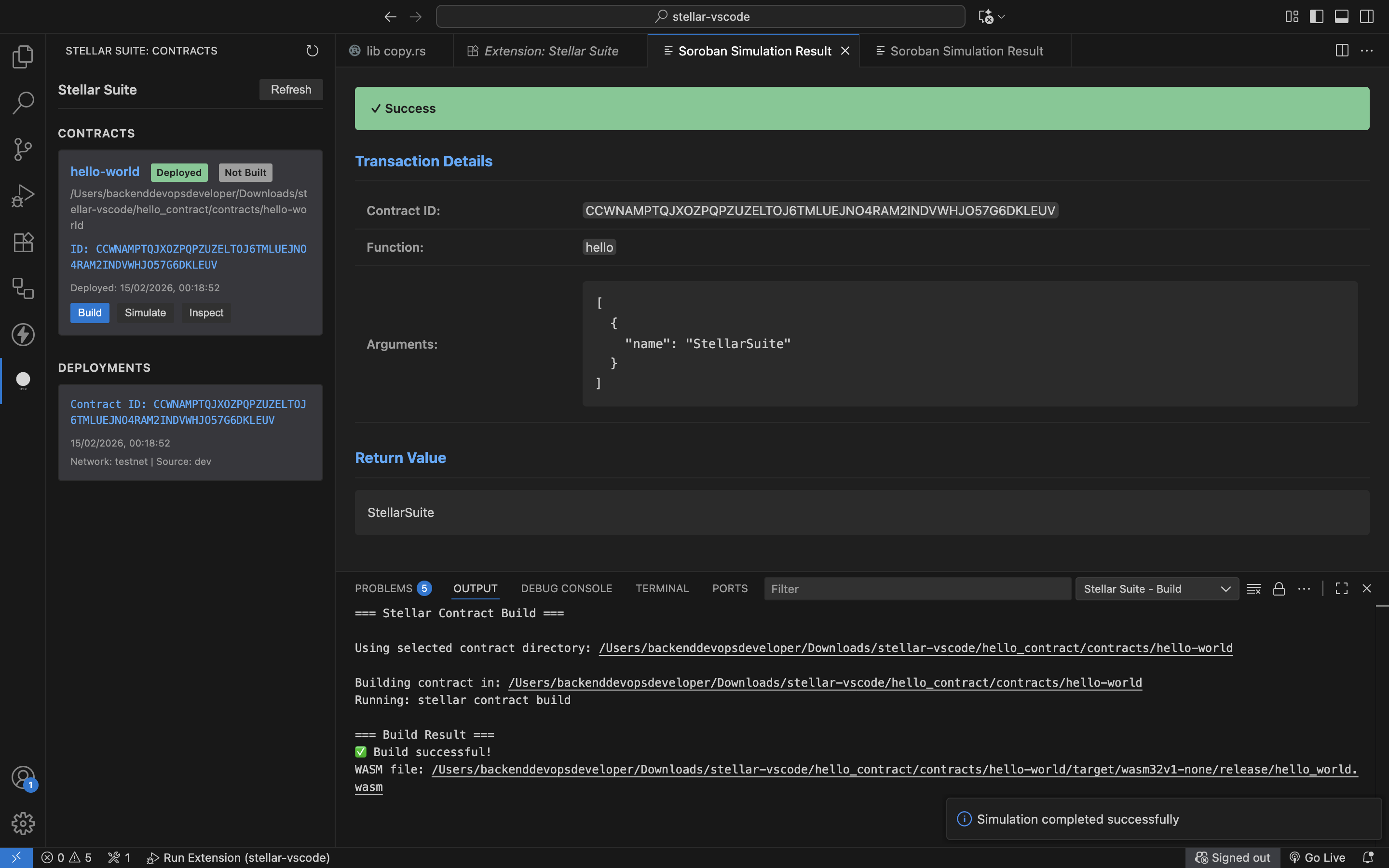 Screenshot showing the current Stellar Suite mvp
Developing Stellar smart contracts currently relies heavily on manual CLI usage. Developers must repeatedly:
- Run build commands
- Deploy contracts through terminal commands
- Copy contract IDs manually
- Track deployment details themselves
- Manually prepare invocation parameters
This workflow works, but it slows development and increases the chance of human error.
Stellar Suite is designed to streamline this process by providing an interactive developer experience directly inside VS Code. The extension integrates with the official Stellar CLI while removing repetitive manual steps.
The first release focuses on simplifying contract deployment, transaction simulation and invocation.
Stellar Suite parses Stellar CLI errors into structured, readable feedback:
- Detects error type (network, validation, execution)
- Extracts error codes and useful context
- Formats detailed error output for panels/output logs
- Provides actionable suggestions for faster recovery
Stellar Suite allows developers to build and deploy contracts using the official Stellar CLI without leaving VS Code.
Features:
- Run contract builds directly from the editor
- Deploy contracts using guided prompts
- Automatically capture deployed contract IDs
- Store deployment metadata for later use
- Display deployment results inside VS Code
- Remove the need to manually parse CLI output
After deployment, Stellar Suite automatically:
- Detects the contract ID from CLI output
- Stores it locally within the workspace
- Makes it available for future interactions
This removes the need to manually copy and store contract addresses.
Instead of remembering CLI flags, the extension provides guided prompts that allow developers to:
- Select network environments
- Select source accounts
- Choose compiled contract files
- Confirm deployment configuration
The extension includes a sidebar panel that displays:
- Detected contracts in the workspace
- Build status (Built/Not Built)
- Deployed contract IDs
- Deployment history
- Quick actions for build, deploy, and simulate
Long-running CLI operations (like contract builds) stream stdout and stderr directly into VS Code output channels so you can monitor progress live, with cancellation support and bounded buffering for large logs.
(Coming soon)
-
Clone the repository:
git clone https://github.com/0xVida/stellar-suite.git cd stellar-suite -
Install dependencies:
npm install
-
Compile the extension:
npm run compile
-
Run extension locally:
- Open project in VS Code
- Press
Fn + F5(Mac) orF5(Windows/Linux) - A new Extension Development Host window will open
- Open your contract project in VS Code
- Open the Command Palette:
Cmd + Shift + P(Mac)Ctrl + Shift + P(Windows/Linux)
- Run: Stellar Suite: Deploy Contract
- Follow interactive prompts to:
- Select compiled WASM file
- Select network
- Select source account
- Choose deployment signing method
Stellar Suite will:
- Run build and deployment using the official CLI
- Run signing workflow before deployment submission
- Capture the deployed contract ID
- Display results inside VS Code
- Save deployment metadata for later use
Deployment now includes a signing phase before transaction submission. Supported methods:
- Interactive signing (prompt for secret key)
- Keypair file signing
- Stored keypair signing from VS Code secure storage
- Hardware wallet signature verification (external sign + paste signature)
- Source-account delegated signing via Stellar CLI
For hardware wallet signing, Stellar Suite copies the payload hash to clipboard and validates the returned signature before deploy.
For local keypair signing and signature verification, install @stellar/stellar-sdk in the extension development environment.
- Open the Command Palette
- Run: Stellar Suite: Build Contract
- Select the contract directory if multiple contracts are detected
The extension will compile your contract and display build results.
- Open the Command Palette
- Run: Stellar Suite: Simulate Soroban Transaction
- Enter contract ID, function name, and arguments
Results are displayed in a formatted panel with return values and resource usage.
Use Stellar Suite: Configure CLI to manage CLI settings with profiles.
You can:
- Create and switch configuration profiles
- Validate CLI/network/source/RPC settings
- Apply active profile settings to workspace configuration
- Export and import profiles as JSON
The Stellar Suite sidebar provides a visual interface for managing contracts:
- View all detected contracts in your workspace
- See build status at a glance
- See detected contract template/category (token, escrow, voting, custom, unknown)
- Access quick actions (Build, Deploy, Simulate)
- Run template-specific actions from the contract card/context menu
- Manually assign template categories from the context menu
- View deployment history
- Inspect contract functions
Stellar Suite supports custom template definitions through a workspace config file:
stellar-suite.templates.json(workspace root), or.stellar-suite/templates.json
Example:
{
  "version": "1",
  "templates": [
    {
      "id": "amm",
      "displayName": "AMM",
      "category": "amm",
      "keywords": ["swap", "liquidity_pool"],
      "dependencies": ["soroban-sdk"],
      "actions": [
        { "id": "amm.swap", "label": "Swap Assets" }
      ]
    }
  ]
}
Each template can define keyword, dependency, and path hints used for detection. Unknown contracts are shown as Unknown / Unclassified until matched or manually assigned.
Stellar Suite can be configured through VS Code settings.
Default network used for deployment.
Path to the Stellar CLI executable.
Source identity to use for contract invocations (e.g., 'dev').
RPC endpoint URL for transaction simulation when not using local CLI.
Use local Stellar CLI instead of RPC endpoint.
Default signing method used when deployment signing begins.
Require a validated signature before deployment is submitted.
Allow saving keypairs in VS Code SecretStorage for reuse.
Example:
{
  "stellarSuite.network": "testnet",
  "stellarSuite.cliPath": "stellar",
  "stellarSuite.source": "dev",
  "stellarSuite.rpcUrl": "https://soroban-testnet.stellar.org:443",
  "stellarSuite.useLocalCli": true,
  "stellarSuite.signing.defaultMethod": "interactive",
  "stellarSuite.signing.requireValidatedSignature": true,
  "stellarSuite.signing.enableSecureKeyStorage": true
}Stellar Suite aims to become a full smart contract development assistant for Stellar developers. The goal is to remove repetitive CLI workflows and replace them with interactive tooling built directly into VS Code.
Stellar Suite is being developed in stages.
Contract Invocation UI
- Select deployed contracts from stored workspace data
- Automatically detect contract functions
- Generate input fields based on function parameters
- Run contract invocations directly from VS Code
Simulation Integration
- Run contract simulations before invoking transactions
- Display execution results in a readable interface
- Show storage state diff (created/modified/deleted entries)
- Show authorization requirements
- Display resource usage metrics
Deployment Profiles
- Save deployment configurations per project
- Allow quick redeployment with saved settings
- Support multiple networks per workspace
Contract Interface Parsing
- Read contract source files
- Extract function names and parameter types
- Automatically generate invocation forms
- Provide autocomplete for contract functions
Deployment History & Replay
- Track past deployments
- Allow redeployment of previous contract versions
- Provide version comparison tools
Multi-Contract Workspace Support
- Manage multiple deployed contracts per project
- Link deployments to specific contract files
- Provide workspace-level contract explorer
Stellar Suite aims to evolve into a full development environment for Stellar smart contracts, including:
- Interactive contract debugging tools
- Execution tracing and state inspection
- Transaction replay tools
- Gas and resource profiling dashboards
- Contract testing and simulation suites
- Visual contract interaction builder
- Multi-network contract management
Contributions are welcome.
Fork the repository and clone your fork:
git clone https://github.com/0xVida/stellar-suite.git
cd stellar-suite
Install dependencies:
npm installCompile TypeScript:
npm run compileWatch mode:
npm run watchRun tests (executes the full suite):
npm testRun specific test suites (e.g., contract deployer tests):
npm run test:contract-deployerDeployment workflow integration suite:
npm run test:deployment-workflow-integrationNote: Unit tests are fully isolated and use mock implementations to prevent actual CLI execution or network access during testing.
- Open project in VS Code
- Press
Fn + F5(Mac) orF5(Windows/Linux) - Test extension inside Extension Development Host
- Keep code modular and readable
- Provide clear error handling
- Add tests when introducing new features
- Update documentation when functionality changes
Stellar Suite follows several guiding principles:
- Reduce developer friction: Minimize context switching and manual steps
- Stay lightweight and focused: Essential features without bloat
- Enhance existing CLI tooling: Work with the official Stellar CLI rather than replace it
- Provide interactive developer workflows: Replace command-line prompts with IDE integration
- Build practical tooling developers actually need: Focus on real-world use cases
The extension is designed to feel like a natural extension of the development environment rather than a separate tool.
Issues and feature requests can be submitted through GitHub.