- Divyansh Goyal
- Netra Patel
- Thomas Truong
- Svetlana Yanushkevich
This repository contains a practical and useable model and its associated files to perform person re-identification through attribute recognition.
The model is featured in the scientific paper, Towards Explainable Person Re-Identification, which has been accepted for publication and presentation at the IEEE Symposium Series on Computational Intelligence (SSCI) 2021. The full paper can be found here.
The paper's abstract is:
Visually recognizing an individual in a crowded area using a distributed camera network is essential for a range of biometric and security applications. We propose a shift in perspective of the ongoing re-identification studies, towards creating more explainable and coherent models that are applicable in real-world engineering problems, even if this comes with a slight decrease in performance. The proposed explainable model uses attribute classification to perform the task of re-identification. This method steps away from intrusive and controversial techniques such as facial recognition to improve public acceptance of re-identification models. Current methods of person re-identification do not explain the importance of each attribute in determining the results, and often use complicated and esoteric algorithms to improve the performance on closed-world datasets which may not represent more realistic open-world scenarios. We applied our approach to the Market-1501 dataset and examined the impact of careful selection of backbone outputs for each individual attribute in our experiment. Our simple model is capable of performing attribute classification for 0-shot re-identification that is explainable and less intrusive when compared to state-of-the-art models focused on re-identification.
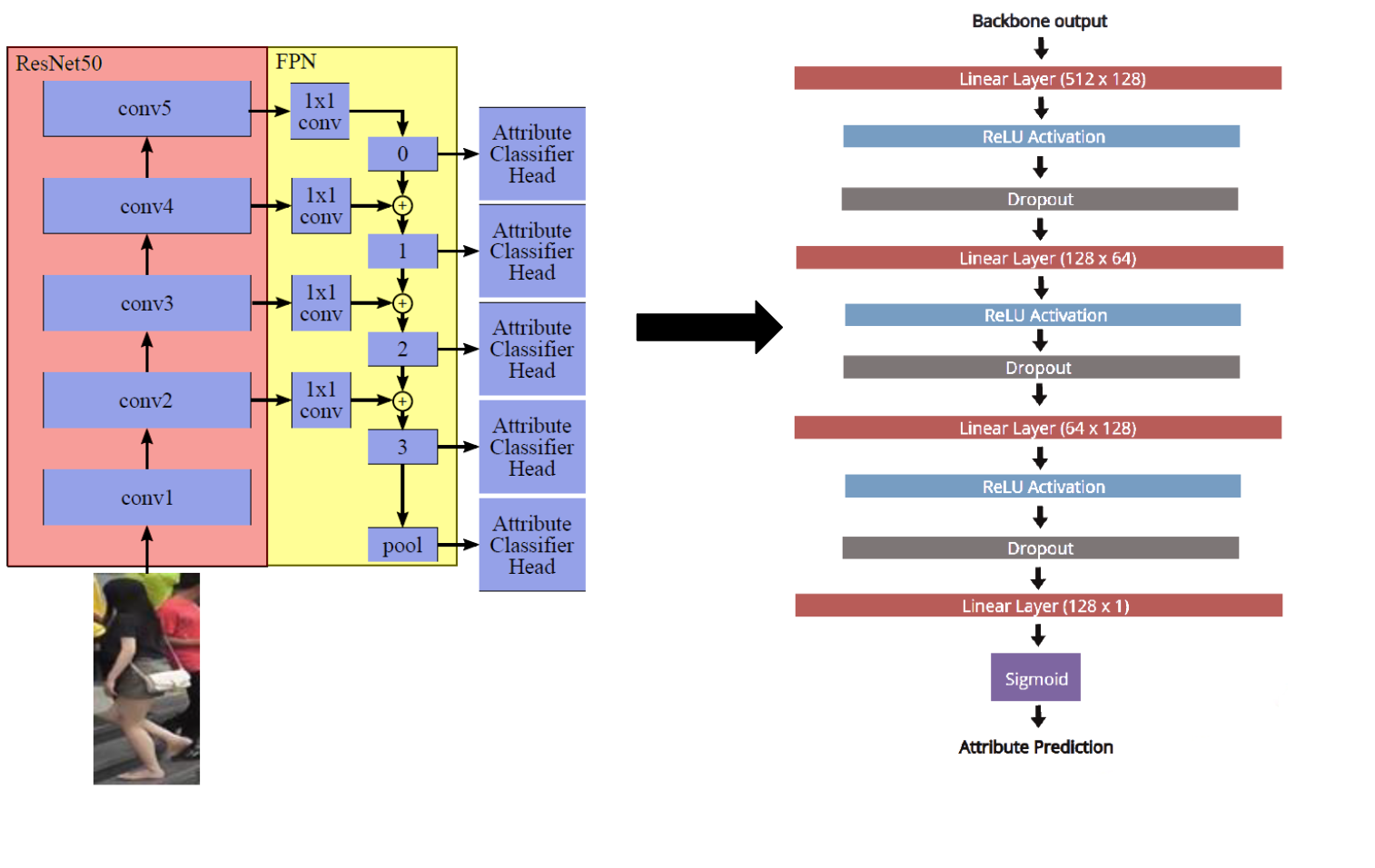
We have applied a ResNet-50/FPN backbone which provides five different output heads, "0", "1", "2", "3", and "pool". Then, we feed in these outputs to a linear classification layer system, which provide attribute predictions for the probe image.
- argparse
- torch
- confuse
- pathlib
- torchvision
- slearn.metrics
- numpy
- tqdm
- pandas
- os
- sys
- matplotlib
- albumentations
- scipy.io
- PIL
To run, install all required libraries and download dataset and update path files in dataset_utils/market1501.yml and model_utils/model_paths.yml, as well as configure the parameters of training and testing in model_util/classifier_architecture.yml. Then, run python main.py when in the src directory and follow the instructions on the terminal.